Introduction
What is a collapsed core network?
We've all probably seen this familiar Cisco textbook network topology before:
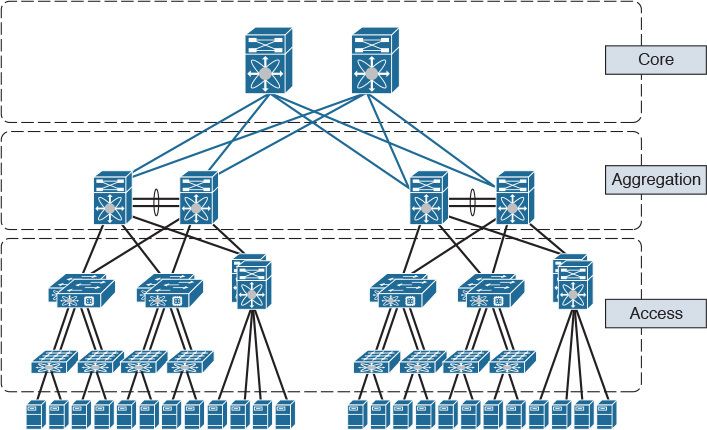
Is anyone building this in K-12 schools? Probably not.
In a collapsed core network, we omit the aggregation/distribution layer, and the access layer connects directly to the core.
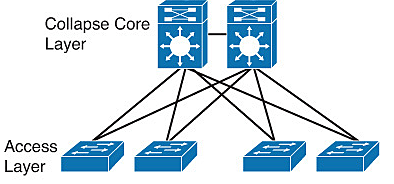
In most school district networks, each building will be configured as a collapsed core, and building cores are connected over a WAN. The core is often implemented using a simple switch stack, which can become a single point of failure for a school or school district.
Our purpose today is to consider a standards-based alternative to switch stacking in the core, and how we might even extend that into the access layer.
What is EVPN-VXLAN?
EVPN-VXLAN is shorthand for Ethernet VPN signaled using MP-BGP over VXLAN data plane encapsulation.
EVPN is used as a Layer 2 control plane to provide MAC learning and bridging information over an IP or MPLS underlay. EVPN also provides Layer 3 control plane information and can simplify deployment of VRFs.
VXLAN is a tunneling mechanism that allows forwarding of Ethernet frames over Layer 3 paths by wrapping them in an IP/UDP header.
Bottom line
VXLAN provides the dataplane for bridging Layer 2 traffic over a Layer 3 underlay, and EVPN provides the control plane for both Layer 2 and Layer 3 traffic in the overlay.
Why use EVPN-VXLAN?
EVPN-VXLAN is most often found in the datacenter where it can help solve problems of scale and mobility in dense environments, so why use it in the collapsed core?
My goals:
- Avoid single points of failure
- Avoid proprietary solutions
Bottom line
Using EVPN-VXLAN in a collapsed core helps us avoid the drawbacks of stacking and proprietary solutions for clustering/fabric and multi-chassis link aggregation.
Beyond the collapsed core
EVPN-VXLAN can be extended across your campus into the IDF/access layer fairly easily, opening the door to more interesting underlay topologies than the traditional hub-and-spoke network, without the need for STP on the backbone. You could also run it in the WAN layer to streamline VRF deployment across the district.
Comparing options
Stacking
Pros
- Convenience: shared management plane makes configuration easy
- Convenience: link aggregation across multiple switches is easy
- Scalability: it's typically easy to add switches to a stack
Cons
- Reliability: if the master switch experiences a fault, the whole stack usually experiences a fault
- Maintenance: software upgrades usually require downtime for a full stack reboot
- Scalability: there's usually a limit of 8-12 switches in a stack
- Scalability: stack interconnect bandwidth may be limited
- Scalability: usually requires a specific interconnection topology
EVPN-VXLAN
Pros
- Reliability: switch control processes are completely separate — each participating device can stand alone
- Maintenance: software upgrades can be rolled out one switch at a time without impacting other devices
- Scalability: can scale to many switches in almost any topology
- Scalability: interconnect bandwidth can be increased when necessary
- Scalability: easy to scale out Layer 3 VRFs
- Convenience: multi-chassis link aggregation via ESI-LAG is relatively simple and standards-based
- Standardization: fully standards-based, supported by many manufacturers
Cons
- Convenience: no synchronization of configuration or state across participating devices
- Cost: licensing is often required